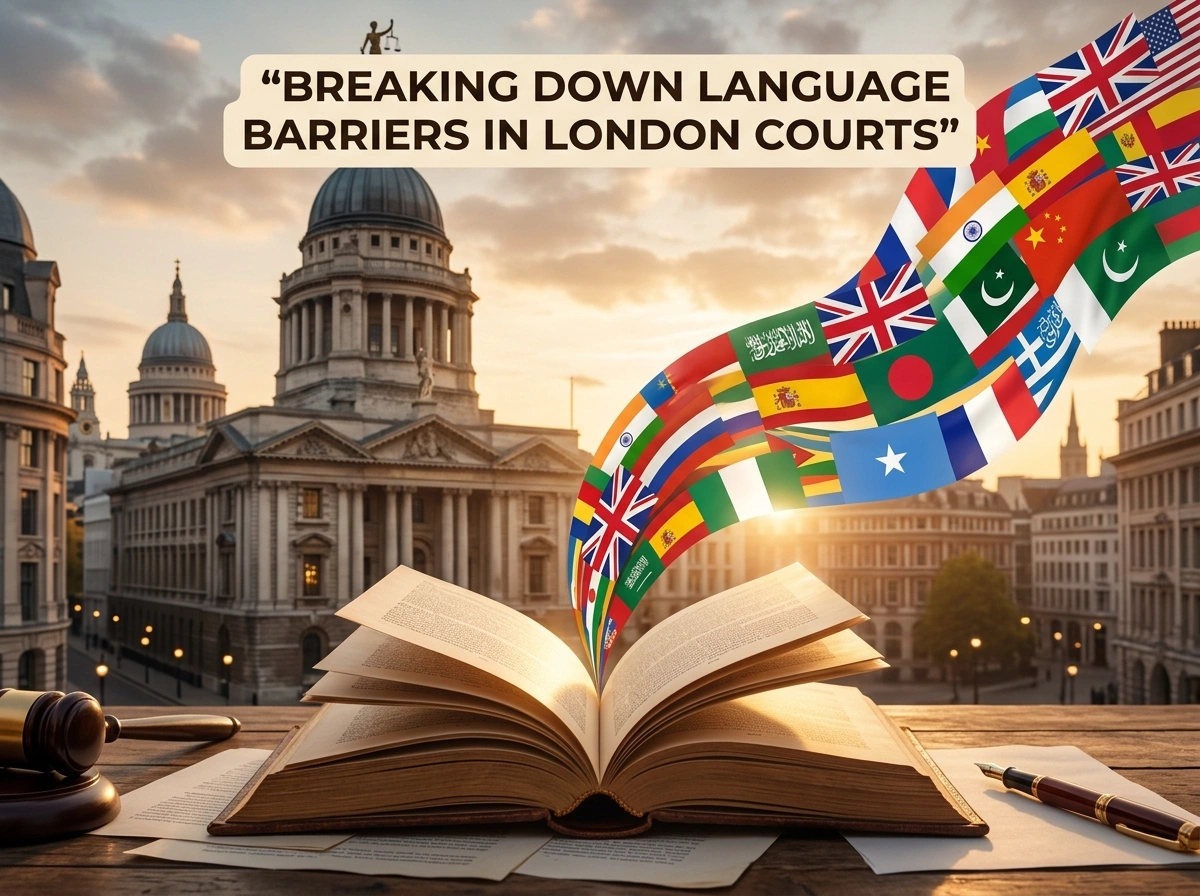
London stands out as a globally recognized hub of diversity. According to the 2021 Census, residents speak over 100 languages across the capital’s 32 boroughs. More than 2.2 million people living in London were born outside the UK. This incredible variety of languages creates a vibrant culture, but it also brings unique communication challenges to public services.
The legal sector faces a particularly high hurdle when it comes to clear and accurate communication. Legal proceedings require absolute clarity and precision. A minor misunderstanding or a poorly translated document can alter the outcome of a court case, affecting lives, families, and businesses. Because of this, courts, immigration tribunals, and law firms rely heavily on language professionals to bridge the gap.
This article examines how translation professionals support the capital’s judicial system. You will learn about the critical need for document accuracy, the impact on access to justice, and the strict requirements set by UK authorities. Understanding this process highlights how language experts help maintain a fair and equal society for all residents, regardless of their native language.
The Critical Need for Legal Translation
The legal system operates on documentation. Every claim, defense, and piece of evidence must be thoroughly documented and reviewed by legal professionals. When these documents originate in a foreign language, they cannot simply be summarized or run through a basic translation app. They require a meticulous translation process to ensure every legal nuance is captured.
Institutions like the Royal Courts of Justice, the Old Bailey, and various immigration tribunals frequently process foreign-language evidence. Documents such as birth certificates, marriage licenses, financial records, and police certificates are foundational to many legal cases. If a document is translated incorrectly, a judge may dismiss it as inadmissible evidence. This can delay proceedings and increase legal costs for everyone involved.
UK Visas and Immigration (UKVI) and the Home Office also demand translated documents for visa and settlement applications. These agencies handle thousands of applications from non-English speakers every year. They require absolute certainty that the translated documents perfectly match the originals to prevent fraud and process applications efficiently.
Ensuring Accuracy and Compliance in Legal Proceedings
Accuracy is the cornerstone of any legal system. A translator working with legal texts must possess a deep understanding of both the source and target languages. Furthermore, they need a comprehensive knowledge of the legal systems in both jurisdictions. Legal terminology rarely has a direct one-to-one translation. A concept that exists in French or Polish law might not have an exact equivalent in English common law.
Translators must navigate these complexities carefully to avoid altering the document’s legal meaning. For example, translating a commercial contract requires precise terminology to ensure all liabilities and obligations remain legally binding under UK law.
Compliance is just as important as linguistic accuracy. UK courts and government bodies have strict guidelines regarding who can translate official documents. A translation submitted to the Home Office or a family court must include a formal declaration of accuracy. This statement confirms that the translation is a true and accurate reflection of the original document, holding the translator professionally accountable for their work.
The Role of Certified Translators in London
Because the stakes are so high, courts and government agencies do not accept translations from just anyone. A bilingual friend or family member cannot legally translate documents for official use. Instead, the system relies on certified professionals who have the necessary qualifications and experience.
Certified translators provide a specific format required by UK authorities. Every translated document must come with a signed certification statement, the translator’s credentials, and their contact details. This process guarantees a clear chain of accountability.
For individuals and law firms navigating this strict regulatory environment, finding reliable professionals is essential. Specialized agencies handle these exact requirements daily. If you need documentation prepared for the Home Office or the courts, you can utilize legal translation services london to ensure full compliance with UKVI and judicial standards. Working with qualified experts prevents administrative rejections and keeps legal processes moving smoothly.
Impact on Access to Justice for Non-English Speakers
Access to justice is a fundamental human right. Everyone deserves the ability to understand the charges against them, read the evidence presented in their case, and communicate effectively with their legal counsel. Language barriers can severely restrict this right.
Certain London boroughs have exceptionally high populations of residents born outside the UK. In Newham, 48% of residents were born abroad, with top languages including Gujarati, Urdu, Romanian, and Bengali. In Tower Hamlets, 41% of the population was born outside the UK.
For these residents, navigating a complex legal dispute or an immigration application is incredibly daunting. High-quality translation services level the playing field. They ensure that non-English speakers can fully participate in their legal matters. By providing certified translations of critical evidence and correspondence, language professionals empower vulnerable populations to seek justice and assert their legal rights.
Challenges in Legal Translation
Translating for the legal sector presents several unique challenges. The primary difficulty stems from the rigid nature of legal writing. Legal documents often feature long, complex sentences and archaic terminology. Translators must decipher this dense language and reconstruct it clearly in English without losing the original legal intent.
Cultural nuances also play a significant role. Different countries have different legal traditions. For instance, civil law systems rely heavily on codified statutes, while common law systems rely on judicial precedent. A translator must understand these systemic differences to convey the correct legal context.
Confidentiality is another major hurdle. Translators frequently handle highly sensitive information, including medical records, financial statements, and criminal backgrounds. Professional translators must adhere to strict data protection regulations and non-disclosure agreements to protect client privacy throughout the translation process.
Technology and Human Expertise in Legal Translation
The translation industry has seen massive technological advancements in recent years. Machine translation tools and artificial intelligence can process large volumes of text in seconds. These tools are helpful for quickly scanning foreign documents to identify relevant information during the early stages of litigation.
However, technology cannot replace human expertise in the legal sector. AI tools struggle with context, regional dialects, and complex legal jargon. They cannot verify the authenticity of a document or swear an oath of accuracy.
UK courts and the Home Office do not accept machine-translated documents. They require a human expert to certify the translation. Professional translators use technology to assist their workflow and maintain consistency across large projects, but human oversight remains mandatory for final certification and compliance.
Future Trends in London’s Legal Landscape
As London continues to grow as an international business hub, the demand for language services will only increase. Cross-border litigation, international arbitrations, and global corporate mergers require constant translation support.
We are seeing a shift toward more digitized legal processes. The UK court system is gradually moving toward electronic filing and remote hearings. Translators are adapting to these changes by providing secure, digital certifications and e-signatures that comply with modern court requirements.
Additionally, the variety of languages required by the courts is shifting. While languages like Polish, Arabic, and French remain in high demand, translators are seeing increased requests for documents in Ukrainian, Romanian, and Somali. Translation agencies must continually expand their networks of qualified linguists to meet the changing demographics of the capital.
Moving Forward in a Multilingual Legal System
London’s legal system relies heavily on clear, accurate communication to function effectively. The city’s remarkable diversity makes language professionals an indispensable part of the judicial process. From immigration applications to complex commercial litigation, certified translators ensure that language barriers do not prevent individuals from accessing justice or conducting business.
Accurate documentation protects the integrity of the courts and guarantees a fair process for all participants. As the legal landscape becomes increasingly globalized and digitized, the partnership between legal professionals and expert translators will remain vital. Ensuring that every document meets strict compliance standards is the best way to navigate London’s multicultural legal environment with confidence.
Contents
- 1 The Critical Need for Legal Translation
- 2 Ensuring Accuracy and Compliance in Legal Proceedings
- 3 The Role of Certified Translators in London
- 4 Impact on Access to Justice for Non-English Speakers
- 5 Challenges in Legal Translation
- 6 Technology and Human Expertise in Legal Translation
- 7 Future Trends in London’s Legal Landscape
- 8 Moving Forward in a Multilingual Legal System